
One Movie Has Given a Lifesaving Treatment a Bad Rap for Decades

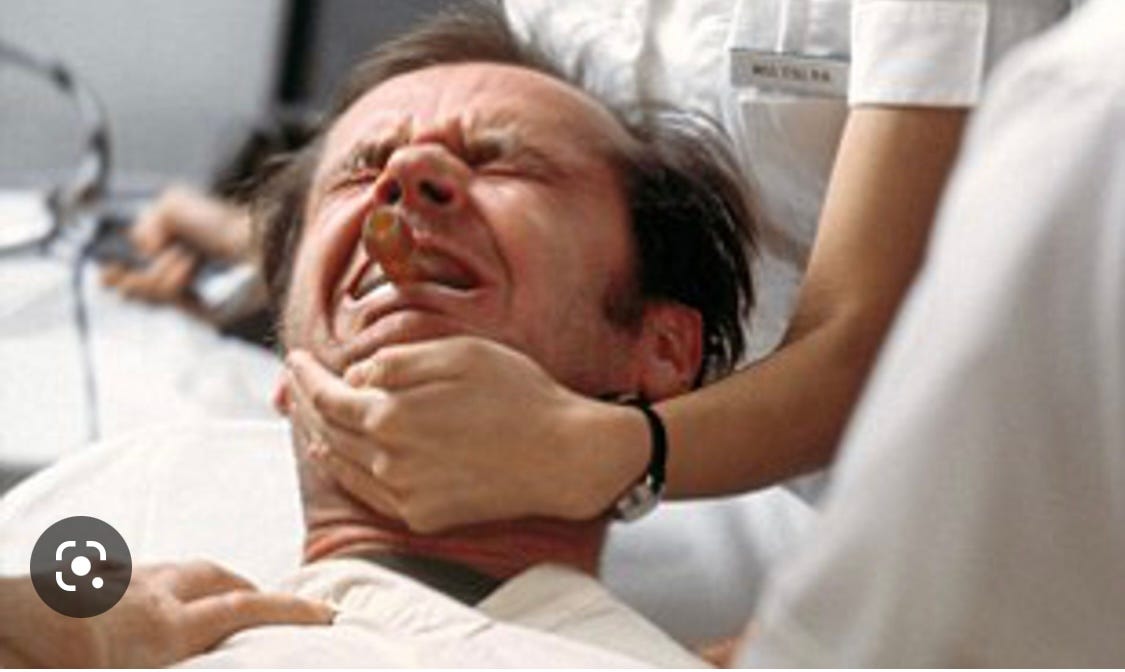
The treatment that is the gold standard for treatment-resistant depression still has a huge stigma surrounding it. And one of the reasons for this is the depiction of this treatment in an old movie, one that I believe still defines peoples’ perceptions of it today.
That treatment is ECT, electroconvulsive therapy. (The word “convulsive” in the name does not help, either). The movie is — you can probably guess, “One Flew Over the Cuckoo’s Nest,” where actor Jack Nicholson, portraying a patient in a psychiatric hospital, is shown being tortured by the evil electric device.
But there are many people who have had this treatment, and it has saved many lives.
You may be surprised to hear of the famous people who have had this treatment. Those of them who came out and admitted they had it, did so, because among other reasons, they wanted to fight the stigma.
One of those people is the witty former talk show host, Dick Cavett. Cavett gave an interview discussing his treatment and how he wanted to be open about having had it, because he knew it had a stigma and he wanted to help fight that.
Cavett called ECT “miraculous” in an interview with the Yale School of Medicine. He had the treatment for his worst depressive episode in 1980. (He was previously successfully treated with antidepressants, in 1974).
Some other famous folks who had ECT: Carrie Fisher, Kitty Dukakis, Gary Gulman, Lou Reed, Judy Garland, Vivien Leigh, and many others.
ECT helped Fisher, the actress who played “Princess Leia” in “Star Wars. “I tell you this, as a newly made bystander. As I have been re-introduced to my life by electroconvulsive therapy. More commonly known as ECT for those oh, so fortunately, familiar with it and electroshock for those who are not — re-introduced to my life at the age of fifty-two,” she wrote in her memoir, “Wishful Drinking.”
And ECT put comedian Gary Gulman on path toward remission.

A successful comedian with two Comedy Central specials under his belt, Gulman said he resisted getting ECT because of — you guessed it — the image that movie gave it. And the old stigma and negativity about it — which is not accurate based on today’s medical standards and advanced technology.
Gulman had tried many drugs to address his depression. But antidepressant drugs don’t work for everyone. And, even if they do work, they sometimes “poop out” and stop working, as in my case, and Gulman’s.
“Gulman had tried almost every combination of medication during 30-plus years with his mental illness,” according to an article in UC Health. “But it would be electroconvulsive therapy (ECT) in 2016 and 2017 that would ultimately set the 47-year-old on a path toward remission and back on the stage.”
Gulman said he resisted ECT or years because of its reputation, and “the name of it was daunting: electro, and then you add convulsive to it — I had these images of Jack Nicholson,” Gulman said. “And then the side effects of memory loss made me even more fearful of it.”
The article goes on to say that Gulman’s experience with ECT “was nothing like Hollywood portrayed. ECT is a procedure where small electric currents are passed through the brain while the patient is under general anesthesia.”
And the article once again acknowledges that movie: “Like many who’d seen the 1975 film, “One Flew Over the Cuckoo’s Nest,” Gulman had imagined what ECT would entail.”
Fear of Memory Loss Issues
Gulman did not experience serious memory loss, nor did I. Nowadays the technology is such that doctors can find ways to limit the effects on memory. And Gulman is coming out with a new book and tour, so his career certainly hasn’t suffered, to say the least.
“It’s not a mind eraser, it’s not dangerous, and honestly, I can say it’s physically painless,” Gulman said.
Rather than wring his hands about who might discover he had ECT, or even a mental illness, Gulman started opening up about his experiences in his act, such as his HBO special, “The Great Depresh.”
“I learned how many lives (ECT) has saved. Lots (of people) have come up to me after the show, or emailed, where ECT was crucial in saving their quality of life,” he said.
And doctors today can obviate for memory loss issues. Dr. Konoy Mandal, a psychiatrist and medical director of UCHealth Refractory Depression Clinic - Longs Peak Hospital, said the treatments have changed dramatically in recent years. “If memory is affected, Mandal said he can change his aim and modify intensity to rapidly improve memory.”
“The exact position of a patient’s memory system relative to their mood disorder circuit cannot be known without a few treatments,” Mandal said in the UCHealth piece, adding that there are 10% of patients who cannot get good ECT treatment without significant memory issues. Those patients are easily identified within a few weeks and they will return to pre-ECT memory function within a few weeks of stopping treatment, according to the piece.
In general, Mandal said “Modern-day ECT has a fraction of the side effects of ECT even 10 years ago.”
Kitty Dukakis
Perhaps the most vocal famous person who has come out of the ECT closet, as it were, and became a big proponent of the treatment is Massachusetts former governor and presidential candidate Michael Dukakis’s wife, Kitty.
Kitty Dukakis went into a deep depression after her husband lost the 1988 presidential election, and she began binge drinking. According to an article in The New York Times, her drinking “masked a long-smoldering depression that eventually led her to receive electroconvulsive therapy, also known as electroshock therapy or ECT.”
Apparently she hadn’t known that the procedure was still used. “She thought it a relic, scrapped after it was depicted as an instrument of torture in the 1975 movie” — you guessed it — “One Flew Over the Cuckoo’s Nest,” according to the Times.
But Mrs. Dukakis was desperate for relief and went ahead with the ECT. And it helped, “to her amazement.”
She wrote that she “felt alive” after the first treatment, and even suggested to her husband that they go out to dinner when he picked her up at the hospital. Dukakis went on to write a book about her experience, “Shock: the Healing Power of Electroconvulsive Therapy,” which she wrote with journalist Larry Tye. And the Dukakises became leading advocates for the therapy.
For Dukakis, the “minor memory lapses” she had were a tradeoff for banishing “her demons,” and “she no longer drank, smoked or took antidepressants.”
This is not to say that anyone undergoing ECT will not have memory loss, or even other side effects. But, having had it myself, and researching accounts of others, I saw it as a choice between a few random memories lost, or basically not being able to enjoy life...and worse, suffering. Very nearly unbearable suffering, for some.
Some people can’t take the pain and choose to end their lives.
I am also not saying that in the history of ECT, people have not had problems with it. Some people did complain of serious memory loss. But that is the old ECT. Modern medicine has adjusted and improved.
So why are we still basing our perception of this lifesaving therapy on one movie that came out in 1975? It’s time to change this.
I know people are ashamed and embarrassed to admit they have depression. But people aren’t ashamed to admit they have cancer. Why should depression be any different?
Fortunately, more celebrities and people in general are being more open about mental illness these days. And it mental illness is an illness that needs treatment. ECT can put depression into remission.
“ECT is one of the most evidence-based interventions around to get a client into remission,” Dr. Mandal said in UC Health. “Remission is not only feeling better. It is being indistinguishable from someone who does not have an illness. It is not a cure but total control of the illness. No other treatment in psychiatry has better data to return a person to their pre-illness functioning.”
Maybe what we need is a new movie. A movie that accurately depicts the suffering of depression, and what ECT today is really like.
End